Leverage Efficiency & Strategic Scaling: My Wealthsimple Margin Buying Plan
Leverage Efficiency & Strategic Scaling: My Wealthsimple Margin Buying Plan
Hey everyone! Today, I’m sharing a major update on my portfolio strategy. My Wealthsimple Margin Joint Account has finally been approved, which means it's time to talk about how I'm using leverage—not to gamble, but to strategically scale my income while keeping risk strictly under control.
Disclaimer: This post reflects my personal buying plan and is for informational purposes only. Margin trading involves significant risk. Always assess your own financial situation and risk tolerance before using leverage.
1. The Starting Point: Ultra-Conservative Leverage
Currently, I am starting from a very safe position. My margin usage is only at about 5% of my total account value.
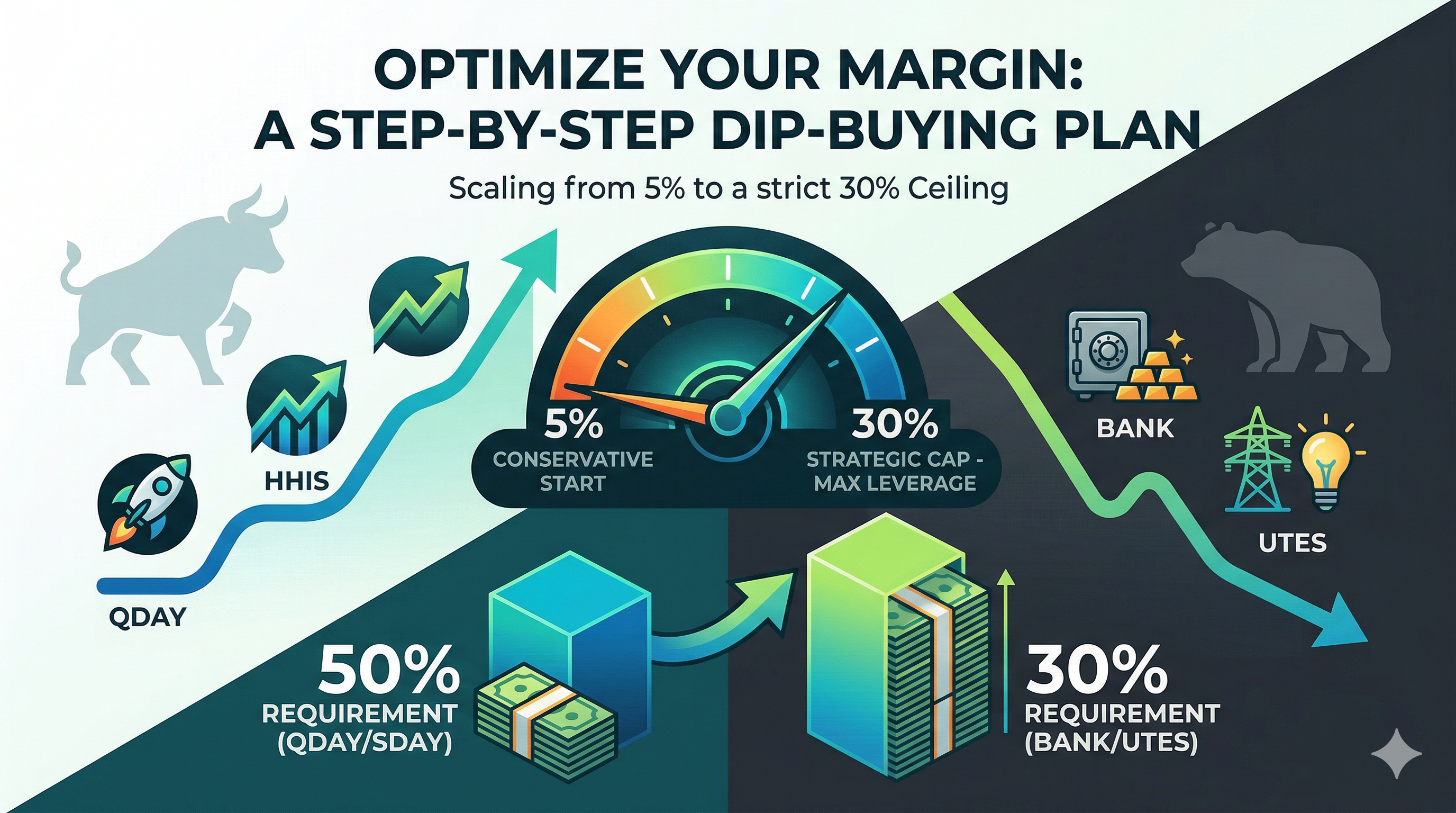
My philosophy is simple: Start small and scale into the fear. While I plan to "buy the dip" as the market fluctuates, I have set a hard ceiling for myself. I will never exceed 30% margin usage, no matter how deep the market drops. This ensures I have a massive "margin of safety" to withstand volatility without ever fearing a margin call.
2. The Core Foundation: My "Anchor" Positions
Despite the new margin capabilities, the foundation of my portfolio remains focused on stable, high-yield ETFs. Currently, QDAY, SDAY, and CDAY make up over 40% of my total assets.
- SDAY & CDAY: These are my "enhanced" defensive anchors for the US and Canadian markets. They provide a stable dividend yield that acts as the bedrock of my monthly income.
- QDAY: This is my aggressive growth engine. While it has higher volatility, its low covered call overlay (approx. 20%) gives it the best NAV recovery potential during a market rebound.
3. Margin Efficiency: The 30% vs. 50% Rule
The main reason I’ve rebalanced into funds like BANK and UTES is their 30% Margin Requirement. In the world of margin trading, efficiency is everything:
| Fund Type | Margin Requirement | Portfolio Power ($100k Principal) |
|---|---|---|
| Newer ETFs (QDAY/SDAY) | 50% | Max position: $150,000 |
| Established ETFs (BANK/UTES) | 30% | Max position: $240,000 |
By focusing on 30% requirement funds, I use less of my own capital to maintain my positions, keeping my overall risk levels much lower while maintaining a healthy cash flow.
4. The Step-by-Step "Buy the Dip" Plan
I don’t believe in timing the market, but I do believe in having a plan for different market depths. Here is how I will scale my margin usage from 5% up to my 30% cap:
Phase 1: The Mild Pullback (S&P 500 down 5-10%)
- Strategy: Conservative margin buys.
- Targets: BANK, UTES, and QQQY.
- Logic: These Evolve funds are known for stable dividends. QQQY, specifically, tracks the Nasdaq-100 without internal leverage. If it pulls back to $24 CAD, the 16% yield is fantastic value. The dividends here help cover the margin interest costs comfortably.
Phase 2: The Correction (S&P 500 down 10%+)
- Strategy: Scaling into high-yield growth.
- Target: HHIS.
- Logic: HHIS yields over 30% but carries 25% internal leverage. I wait for a 10% drop before buying to ensure a better margin of safety. Because it has a 30% margin requirement at Wealthsimple, it is incredibly capital-efficient.
Phase 3: The Market Crash (S&P 500 down 20%+)
- Strategy: Aggressive Rotation & Maxing the 30% Cap.
- Action: Sell OILY and GLCL; rotate everything into HHIS or CLSA (Split Share Fund).
- Logic: Energy and Gold are great hedges, but they lag during a sharp rebound. In a total crash, I want high-leverage assets with massive recovery potential. This is where I would reach my 30% margin limit.
5. NAV Recovery: Why I Trust QDAY over BIGY
When buying dips, I care most about NAV (Net Asset Value) recovery.
- QDAY is my top pick because its low call coverage allows the price to run up during a recovery. But it has 50% margin requirement.
- BIGY, on the other hand, uses a 50% "at-the-money" strategy. While the yield is high, it often "caps" its own growth, making it much harder to recover its share price after a major drop.
Final Thoughts
My strategy is a staircase: As the market goes down, my aggression goes up—but only to a point. By starting at 5% and capping my leverage at 30%, I can sleep soundly knowing that I’m prepared for the worst-case scenario while still being positioned to profit from the recovery.
What is your "hard limit" for margin usage? Do you prefer staying unleveraged, or do you use it to buy the dips? Let me know in the comments!
If you found this breakdown helpful, don't forget to subscribe for more hardcore ETF analysis and portfolio updates!